Keep up to date

Keep up to date with the latest posts David's Bat Blog on Facebook

Showing posts with label anabat. Show all posts

Saturday, 21 August 2021

Looking after your bat detector - guest blog by Andrew Dobson

Andrew Dobson is the UK face of Titley Scientific, the company which makes the Anabat range of bat detectors. I've known Andrew for over a decade and every time I meet him he always has some useful tip, or else a sad tale of us non-engineering ecologists ill-treating his beloved equipment. I persuaded him to distil some of these hints into a guest blog for us.


Deploying a remote download system back in 2013


8 years ago, I found myself taking over Titley Scientific UK & European distribution, selling and servicing Anabat bat detectors. After emigrating to Australia in 2007, it was 2012 and time to come back to the UK - especially with the arrival of a new baby. Around this time, Titley Scientific was being taken over by the Australian company I worked for. They needed someone in the UK to look after things and I thought to myself, ‘why not?’ Moving to Australia in the first place was a massive risk, hence, coming back with a job opportunity this time was hard to refuse. 

By this point, I had almost 20 years experience in electronics. Fortunately, this meant fixing Anabat bat detectors was relatively straightforward for me, just slightly different to work I had done before. As comfortable I may be with anything electronically related, I will admit that I am no salesman. Personally, I do not really believe people working with this equipment need a ‘shiny salesman’, but more of an honest and genuine person who tries their best. People like Chris Corben and Richard Crompton were around well before me, promoting all things Anabat. From this, the community was already aware of Titley products, which gave us the best chance of succeeding. In fact, everything was there for me. The only shortfall I could see was the technical expertise needed in the UK and hopefully I filled that gap.

Since starting, I have had some amazing experiences all over Europe and met many amazing people. In particular, I remember being in a cave in Portugal, where was told to close my mouth if I did not want bat pee in my mouth! This was definitely a highlight for me. 

Like any career serving people, I have had the odd difficult customer or made the odd mistake, but in general I think I have done well. I try my best and most people appreciate that. Chris Corben is the brains behind the original Anabat kit and is still working hard to help along with the team in Brisbane. Chris cannot help enough and I will always be grateful for his help. 

Within a few weeks of starting, I found “David’s Bat Blog”, and decided to make contact. David was a friendly and welcoming contact, so I gravitated to his hospitality. Back in 2013, we deployed a remote download system and solar panel near him, which recorded bats all year round  – I never quite managed to get a go in his glider but hopefully there is still time for that :-)    

8 years in and I have probably taken apart more bat detectors than most, so when David asked for a guest blog post it made sense to try and make it useful and talk about what I know (not bats!). Here are some pointers to help folk care for their field kit and avoid common errors: 

Disclaimer: I only work on Titley products, but in general all bat detectors on the market need a sensitive microphone element and run on batteries, so this info is useful for most bat detectors regardless of brand.  Also, the vast majority of units sold do not fail, I am only talking about a very small number. 

Batteries  

Leaking alkaline batteries and resulting damage in an Anabat Express


Alkaline batteries leak, that is pretty much it. If you would like to use them then that is always the risk. This is mainly due to being run flat, left in kit or get too hot. Electrolyte comes out and eats everything it its path. SD1’s were forever coming back with heavy corrosion. I soon found out people thought leaving them with AA’s in all winter was a good idea as it prolonged the life of the clock battery. This is, in fact, the absolute worst thing to do, as they eventually run flat and leak. There was some myth that leaving them would prolong the clock battery, but this is only true if the unit is turned on. Now we have the Anabat Swift, this has amazing battery life and can work on 4 or 8 AA’s. The downside is, if you fit 8 AAs and have just one the wrong way, it will work fine due to the voltage still being within the correct range, but that one alkaline fitted backwards leaks immediately and can really damage the detector.

If you must use Alkalines, here are some musts!

1.      Check and double check they are fitted in the correct orientation.

2.      Take them out when not in use.

3.      Avoid the pack of 40 that are unbelievably cheap.

 You can even see what the battery voltage is in the menu, so maybe its worth spending a few seconds checking its around 12v with new batteries.

I recommend Eneloop rechargeables where possible, and to clean the contacts with a pencil eraser from time to time. If you cannot get Eneloop, stick with well-known brands. Why risk buying “amazing value sponsored batteries” that Amazon are trying to push on you?  

Microphones

By definition, microphones are delicate sensors that convert sound waves into an electronic signal.  Pointing one of these to the sky for 6 months in all weather, and expecting it to be consistently sensitive from start to finish is probably a mistake! All manufacturers say, “weatherproof/waterproof”, but also caveat that with, “avoid something or other”. In my experience, it is best to avoid all rain to get the most out of them. Obviously, this is not always possible, so pointing away from prevailing weather and slightly down (omnidirectional mics pick sound up from all around anyway) is your best bet. Water building up on the microphone will also block the sound from getting through until it dries out, so your recording quality will suffer. Make sure you read and follow any microphone care instructions provided with your equipment.

Corrosion

Most passive detectors (the type that you leave out in the field) are now waterproof, so prevent wetness getting inside. This generally means they are pretty good at preventing moisture getting out as well (some now have vents for this). Opening them in the pouring rain, then getting the inside wet and closing the waterproof case traps the moisture inside. This is when it can go to work corroding everything, but mainly the power connections, as they can get slightly warmer than elsewhere. Active detectors (the type you use while carrying around) are generally not waterproof and care should be taken to avoid getting them wet.

SD cards

They get old and slow, then slow detectors down and cause issues. It helps to re-format them from time to time. For tiny zero crossing files this is usually not an issue, but full spectrum .wav files are 1000 times bigger, so speed is king. Go with class 10 and a write speed of over 120mb/s. Also, never EVER use those horrible micro SD cards in those crappy holders, you are introducing another dozen tiny connections that can fail!

It’s not working

If it is not working, unfastening, or responding to your presses; generally using 10 times more force is not the answer. If the microphone does not unscrew, it is probably not a good idea to use enormous pliers. When things do not work as normal, just give it a few seconds and try again. Maybe even take the batteries out, give it a few minutes and try again. Bat detector manufacturers do not have the resources of Apple or Samsung, but will always help you to get issues sorted out as soon as possible. With bat detectors, generally check for firmware updates at the start of every season, unless the product is brand new. You could also subscribe to email notifications for firmware updates where possible (Titley does this).

Service in Winter

Requesting your kit to be checked or serviced the day before the season starts does not help anyone. Particularly, since, whoever is servicing them probably already has plenty of work to do. Sending kits to be serviced in winter gives plenty time to have them looked at and fixed. They can also have their alkaline batteries that were left inside since September removed and disposed of.

Respect your kit

It’s that simple, just look after it. Store it in a dry place at room temperature, keep it clean and take batteries out when not in use. After use, if the case & mic are wet, leave it open with the mic still fitted for a day or two if possible. If it comes to the point you need to return something, wrap it accordingly – couriers like to damage things!

Hopefully, that helps a little to get the most out of your kit and save yourself some money in repairs. Each new product we release has improvements on the last, so progress is being made to help. Our latest will be the Chorus, which is our entry level passive detector. Its design builds further on our years of experience making and servicing bat detectors.


The new Titley Chorus bat detector & acoustic recorder


Titley Scientific on Facebook

Titley Scientific website


Andrew has kindly lent me a prototype Chorus to try out - I'll post some thoughts about it very soon.


Keep up to date with the latest posts Facebook.com/Davidsbatblog

Monday, 2 February 2015

The new generation of unattended bat detectors

It's been a little while since I wrote a blog post, which has irritated me as I have a host of subjects I want to write about, but so little time to do it. However, the inevitable bat worker calendar effect has happened and I am looking out of the window at deep snow and reflecting on the fact that my "to do" list is the shortest it has been for about a year. This wonderful situation won't last long so I'd better get blogging!

Back in 2011 I wrote about the rivalry between Titley Electronics and Wildlife Acoustics, whose Anabat SD1/2 and Songmeter SM2BAT were at that time the only realistic options for unattended monitoring of bat calls. Both machines had strengths and weaknesses, both were (and still are) very widely used by ecologists and bat researchers.

In the past year both companies have launched new unattended bat detectors. In both cases they seem to have listened to customers in an effort to improve on their previous models. It is interesting that the result of their market research has been very different. Wildlife Acoustics moved up-market with a signficantly more expensive machine, the SM3BAT and Titley went for a smaller and cheaper machine, the Anabat Express. I am fortunate enough to have had my hands on both machines for the past year and have had an opportunity to put them through their paces.

Wildlife Acoustics' Songmeter SM2BAT and the slightly improved SM2BAT+ have achieved much popularity in the UK and elsewhere in recent years. Their price tag of around a thousand pounds made them cheaper than the Anabat SD2, though still expensive for non-commercial users. Their ability to record from two microphones at once was attractive, especially for those wanting to record at height and at ground level simultaneously and the fact that they recorded to SD cards, rather than the dated CF cards used by Anabats was also attractive. However they were complex to use, requiring careful setting up and were easy for the inexperienced user to get wrong.

Perhaps Songmeter's most attractive feature compared to the Anabat was that they came in a waterproof case, whereas Anabats needed an additional weatherproof box - Pelicases for the well-heeled, sandwich boxes for others! The  Songmeter's big selling point was that it arrived oven-ready, without the need to fabricate a waterproofing solution. However they suffered from condensation at times and the internal memory card holders were vulnerable to damage when inserting the massive D cells the machines use. Exposing the internal workings of the machine to change batteries or memory cards in inclement weather was hardly ideal, though the SM2BAT+ model had it's internals sprayed with a water-repelling coating to improve this.


Anabat SD1 and SD2 models need additional waterproofing for unattended use. This sandwich box is the low-tech approach!


An SM2BAT mounted at the base of a mast, with one microphone attached and another at the top of the mast, connected by a cable.


Unlike Songmeters, Anabats (this is an SD1) can also be used for transect work.

The Anabat SD2 (and the previous SD1 model) by comparison, though about 35% more expensive was more robustly built (waterproofing aside) and much easier to use, reducing the risk of expensive repeat surveys. They also use standard AA cells, rather than the larger D cells used by Songmeters (though both can also be connected to external 12v batteries for longer term use). They also have the advantage of being excellent for hand-held transect surveys, whereas the Songmeter can only be used passively.

So given all these pro's and cons I was intrigued to see what the two new machines are like and how the two manufacturers have responded to the feedback of their customers.

The Songmeter SM3BAT was the first of the new machines to reach me. One of the criticisms of its predecessors was that they were a bit "plasticky" and some parts were easy to damage. My first impression of the SM3BAT was that it had been cast in a furnace, rather than built! It's taller than the old machine and the case appears to be capable of withstanding having cattle tap-dance on it (a more common issue with this type of equipment than you might think), though I wouldn't recommend experimenting with that. It's also heavy at 2.5Kg without batteries. The solid metal casing includes holes for securing the machine, either by bolting it to a wall or by attaching it to something solid with a bicycle-lock style cable.


The SM3BAT in use. The microphone is at the end of the cable on the right, allowing the machine to be put out of sight if necessary.

The controls and screen are now on the outside of the machine, with robust plastic to protect them. Battery compartments and memory card compartments are accessed by removing waterproof plugs on the side, so that there is no longer any reason (or indeed any ability) to access the interior of the case. Thus several criticisms of the SM2BAT are removed - the new machine feels solid and robust, it gives confidence that it can cope with whatever is flung at it.

In use the SM3BAT is similar to the SM2BAT. It can record in ZCA (Analook) format, or in WAC or WAV formats. As before there are four memory card slots to allow you to provide the machine with plenty of space for the latter two memory-hungry modes. Wildlife Acoustics are proud of the fact that it is compatible with the latest generation of 256GB SD cards, providing potentially a Terrabyte of memory. A big criticism of the SM2BAT was the memory-hungry nature of Wildlife Acoustics' preferred WAC format. With advances in computer technology the ability to store and process large amounts of data has become steadily easier since then, though that burden should still not be underestimated if you plan to use these modes.

The SM3BAT comes with an upgraded microphone, which like the SM2BAT one is omnidirectional (a key difference to the Anabat SD1/2 microphones, which are unidirectional). However it is significantly bigger and can no longer be plugged directly into the side of the casing. Wildlife Acoustics advise it is more sensitive than their previous microphone.

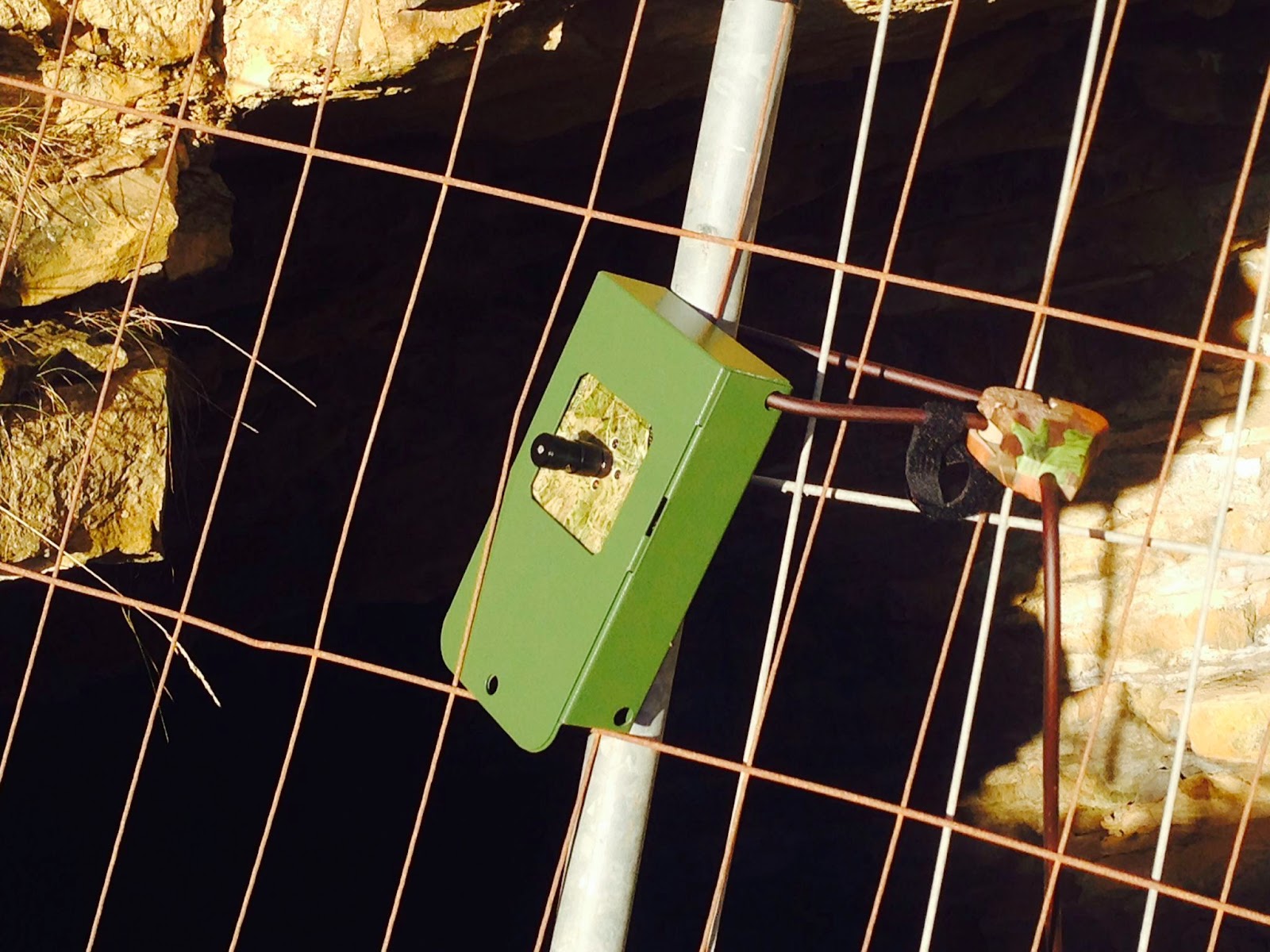
Titley Electronics' new machine is the Anabat Express. They have chosen to produce something much more compact and with less visual impact than their competitors machine. The Express is a similar size to the old Anabat SD1/2 but is now in a camouflaged waterproof case. The case, though made of plastic is strongly made and similar to those used for camera traps. It now has an omnidirectional microphone, which is stored safely in a slot within the case and then screwed into the exterior for use. Unlike the SM3BAT the Express has a built-in GPS, which it uses to calculate sunset times (the Songmeters need to be programmed with their location to calculate this). This is a big step forward for Anabat. Titley's previous models could only be programmed to start and end recordings at fixed times, with no allowance for day-by-day changes in sunset and dawn times. Songmeters have the useful facility to start and finish at a set time in relation to sunset or dawn. Now the Express can do this, with the added bonus that it doesn't need to have latitude and longitude pre-programmed, as with Songmeters.


The diminutive Anabat Express, with a £2 coin for comparison.


The interior of the Anabat Express, including built-in instructions.

In use the Express is virtually idiot-proof (believe me, I'm an excellent measure of this). When we're out in the field, setting up equipment and it's cold or wet and we've been working all day even the best ecologist or bat-worker is liable to do something daft - we're only human after all! The Express even has step-by-step instructions pasted to the inside of the lid. All you have to do is connect the microphone to the outside, switch it on and wait for the GPS to get a signal. Then you cycle through three options for recording time (continuous, sunset to dawn or pre-programmed), close the case and you're ready for action. A cord attached to the case ends in a magnet, which can be used to check the machine is functioning correctly. A friendly blue light winks to confirm all is well when the magnet is placed in the right position on the case.

The Express uses standard SD cards, with no prior set-up, so formatting CF cards is a thing of the past. Of course, unlike the Anabat SD1/SD2 this machine isn't suitable for transect or other hand-held work - it's only effective as an unattended detector. It only records in ZCA format, so if you prefer to use audio recordings for analysis this is something to think about. Personally I prefer ZCA for most purposes. I'm not thrilled about the fact that you have to open it up to operate it - that was one of my criticisms of the Songmeter SM2BAT. However, the interior of this machine is far more robust than the SM2BAT and, like the SM2BAT+ the interior has been sprayed with a water-repelling coating.

So Titley have chosen to go for a low-profile, simple-to-use machine, whereas Wildlife Acoustics have gone for a big, solid, bomb-proof detector. Which would I buy? As ever it's a case of horses for courses. The SM3BAT suffers from high visibility but balances it by being massively robust. It would be hard to install it in a situation where theft or vandalism is a concern. Not only is it big and obvious it looks expensive. Your average thieving ned couldn't help but wonder what it will fetch on eBay. Although it can be securely attached to something, that wouldn't protect the controls or the battery and SD card compartments from interference. At over 2.5Kg before you put batteries in, you wouldn't want to carry a rucksack of these machines around a site for temporary installation. However you might choose it as the ideal machine for long-term installation on a met mast, or somewhere where unauthorised interference can be prevented.

The Anabat Express on the other hand doesn't suffer from these security issues. It's small and camouflaged and therefore suitable for installation with low visual impact, perhaps in places with regular visitors. It comes in a protective zip-up case and you could happily carry a dozen of them with you all day. So for short-term, high risk installation it couldn't be better and I like many others already have several of them for that purpose. If you do want to install one in a higher-risk situation Titley sell a steel case and steel python cable, allowing you to attach it securely to something solid. The Express is also very easy to set up in the field, so the risk of mistakes is low. Unlike the older Anabats you don't need to worry about where the microphone is pointing and it lends itself to attachment to a tree trunk or similar.


An Anabat Express in use with Titley's optional security system

There are a couple of other issues to consider in comparing the two machines. One is power consumption, Wildlife Acoustics claim that the SM3BAT is less power-hungry than the SM2 models were and claim up to 20 nights on a set of four Alkaline D cells. It can also be used with an external 12 volt battery or power supply. The Express can last for up to 30 nights if you use Lithium AA batteries (high capacity Lithium batteries are not an option for D cells, so far as I know). you cannot connect an external 12v battery to the Express, so it's not a machine for long-term use, though 30 nights is a long monitoring period!

The other thing to consider is price. Wildlife Acoustics have abandoned their £1000 price point with the SM3BAT, which sells for over £1400. This compares with £660 for the Anabat Express. In other words you can have two Expresses for the cost of an SM3BAT and still have money left over. I supsect this is the clincher. Both are good machines, both appear to work extremely well and I have had no problems with reliability of either machine. But two machines for the price of one is hard to ignore, especially when the Express is also less likely to be stolen or vandalised and easier to deploy in numbers across a site. For bat groups and those working on a budget the decision seems like a no-brainer. But if you want a long-term installation or if you want something with a well-engineered and professional appearance perhaps the SM3BAT has something to offer.

It's particularly interesting that Wildlife Acoustics have now launched a smaller, lower-cost, ZCA mode only model called the SMZC. From the little I have seen it seems extraordinarily like an attempt to emulate the Anabat Express, though it still has the look of something made in a foundry and weighs 1Kg (the Express weighs 385g). It also lacks the GPS functionality of the Express, but is priced about 10% cheaper, so it may turn out to have something to offer.

Please note that all prices quoted include VAT and appear to be correct at the time of writing. All weights exclude batteries. 

See our website: David Dodds Associates Ltd

Thursday, 20 February 2014

Two steps up for bat monitoring?

I've written before about my hope that the rescue and revitalisation of Titley Electronics (makers of Anabat) would result in a shake-up of the market for unattended monitoring equipment. With Titley and Wildlife Acoustics (makers of the Songmeter) battling for the marketplace the winners will be those of us who use their equipment. With remarkable symmetry both companies have looked at their existing offer, listened to customer feedback and both are launching ground-breaking new machines. Interestingly they are also swapping places in the cost stakes.

Wildlife Acoustics appear to have addressed a lot of the issues with their SM2BAT with their new SM3BAT. With a die-cast aluminium case it will be more robust than the previous machine. They have also addressed problems with cumbersome access and risk of letting water inside the unit. The control and screen are now on the outside of the case, making them more accessible and the batteries now slide into slots in the side of the machine. 


The new Songmeter SM3BAT from Wildlife Acoustics
(Photo copyright Wildlife Acoustics)

The Wildlife Acoustics approach of recording in ZCA (Analook) format as well as in compressed WAV (audio) format is strengthened by a massive increase in memory to a Terrabyte, allowing those large files plenty of room for a change. Another problem with the old SM2BAT was the vulnerability of the microphones and W.A. have a new and more robust microphone for the SM3BAT. They also claim an improvement in power consumption and there is no longer a need for an adaptor to use an external battery.

It all sounds very promising. The downside is that they have abandoned the £1000 including VAT price point to pay for the improvements and I understand the SM3BAT will market at £1500. The new microphones are also double the cost of the old ones at £200 each. A big increase, but maybe worth it?

Titley are countering by moving downmarket with their new Anabat Express. At just £500 each you could buy three of these machines for one SM3BAT (though the SM3BAT can record from two microphones concurrently, if required). 


The new Anabat Express
(Photo copyright Titley Electronics)

Compared with the older SD1 and SD2 Anabats the Express is very different and, like W.A. Titley have listened carefully to customer feedback. A key reason why people started buying SM2BATs in preference to Anabats was the the Anabat's lack of integral weatherproofing. The Express is built into a stout weatherproof case, screen-printed with camouflage. The case is little bigger than the original Anabat machines, making it rather smaller and neater than the SM3BAT. The older chunky Anabat microphones have given way to a new and smaller mic. Happily Titley have finally given up on CF memory cards, moving to the ubiquitous and smaller SD card (in fairness they had already done this with the Roostlogger).

Titley also claim a significant improvement on power consumption and the Express uses 4 AA batteries. Oddly in the SM3BAT W.A. have chosen to carry on using 4 large and heavy D cells.


This interior view of the Anabat Express, with AA batteries in place shows how small this low-cost machine is. 
(Photo copyright Titley Electronics)

The Express also has built in GPS for the first time. It's not really a hand-held unit, so the purpose of the GPS receiver is to allow the machine to calculate sunset and dawn times, making it possible to programme the machine to start and stop recording at times relative to these, rather than fixed times. This was always a strength of the SM2BAT, compared to the older Anabats, which require regular reprogramming through the season.

It's great to see both companies listening and innovating and it will be interesting to see what these two new machines are like in practice. W.A. have a habit of making equipment complex to use in the field, which is fine if you're a bit of a techno-geek, but more of a problem if you're just an average bat worker. Titley's previous machines have always been relatively user-friendly, though the manuals for their previous models have been unintelligible! Whether all these innovations deliver the goods remains to be seen. Happily both manufacturers have been kind enough to offer me machines to try out.

On paper it looks like W.A. are aiming for the gold standard with the SM3BAT, though it's costly and more visible, therefore potentially vulnerable when left in the field. The Anabat Express, with its low price-point could be bought in quantity and its small size and camouflaged appearance makes it potentially less vulnerable. If both machines live up to their promise it could be a case of "horses for courses". For long-term placement on a wind farm Met mast the SM3BAT could be ideal. For large scale deployment over a site the Anabat Express could fit the bill. Time will tell...

Visit our website:www.daviddoddsassociates.com
For regular updates follow us on LinkedIn & Facebook
(David Dodds Associates Ltd) or on Twitter (@DavidDoddsAL)

Thursday, 14 February 2013

A bright new future for Anabat?

The announcement last autumn that Titley Electronics, manufacturer of Anabat had gone out of business was something of a blow. I have never had much good to say about Titley themselves - their abysmal customer service was only latterly mitigated by a helpful UK office. But the Anabat is an excellent bat survey tool and one that would be missed. Furthermore, it was a design that had a great deal of potential for future development (though Titley's developments of it tended more towards gimmick than improvement).

The reaction to Titley's demise was swift. Their only real competitor, Wildlife Acoustics appeared to step up their marketing and Anabats started appearing on eBay for surprisingly low prices. At the end of October came the welcome news that the ashes of Titley had been bought by Elexon, an electonics company specialising in mining equipment.


Since then things have been quiet, presumably whilst the new organisation settles in. Before Christmas I had an interesting conversation with Andrew Dobson, the new UK agent for Titley. Whilst it is too early to make judgements, Andrew is upbeat about Anabat and indicated that Elexon might be keen to fund further development of Anabat.

For those in the Uk with an interest in Anabat, Andrew is hosting an open day at the new Titley Scientific UK office in Coppull, Lancashire on Tuesday 26 February. Chris Corben, the designer of Anabat and Kim Livengood will be flying in from the US and will be delivering free training sessions on a variety of Anabat-related subjects. Having attended Chris and Kim's Anabat seminars in the past I can confirm they are always interesting.

The open day is from 9am to 5pm at the Titley office at Coppull Enterprise Centre, Mill Lane, Coppull, Lancashire PR7 5BW. If you are planning to attend and would like to suggest a subject for Chris to cover email Andrew Dobson: andrew.dobson@titley-scientific.com

Visit our website:www.daviddoddsassociates.com
For regular updates follow us on LinkedIn & Facebook
(David Dodds Associates Ltd) or on Twitter (@DavidDoddsAL)

Sunday, 17 June 2012

The Echometer EM3: The machine I love to hate

Ever since I got my hands briefly on a pre-production example of Wildlife Acoustics Echometer 3 (EM3) late last year I have been looking forward to trying one out in the field. This machine has been much discussed by professional bat-workers: a detector with heterodyne, time expansion and frequency division functionality, SD card recording and the ability to display live sonograms on a built-in screen represents a  step forward in bat survey technology. Now that I have had a few months to try one out for real I have two things to say about it:

1. Do I like it? No, I don't.

2. Would I buy one? Hell, yes.

At first sight that doesn't appear to make much sense, so perhaps I should explain...


The Echometer EM3

(Photo copyright, Wildlife Acoustics Inc)

I don't intend to recite the capabilities of the EM3. You can look that up for yourself on the Wildlife Acoustics website and in any case it would take too long. This machine is packed with functionality, and it's packed into a surprisingly small box. So I shall leave you to do your own research and tell you what I think matters.

First of all, the facility to view live sonograms (and oscillograms) is incredibly useful, allowing faster and more conclusive species identification in the field. I have long been a convert to this, having been using an Anabat-PDA combo in the field for several years. However, this has always been a large, cumbersome set-up and one that is clearly a bit of a bodge-up. It's also a bodge-up that costs an outrageous amount of money (but that's the Titley Electronics way of doing business: marry up minimum product to maximum price and factor in poor quality control for good measure!). So having the screen in a more convenient and much cheaper box should appeal to me, right? Actually, in use I found the EM3's display clarity disappointingly poor, compared to the lovely clear picture you get on a PDA screen.

In terms of functionality, the EM3 allows you to record in WAV (normal audio), WAC (Wildlife Acoustics own compressed WAV format) and also ZCA (Anabat) format. Including ZCA is great, as it means that you can use Analook to analyse calls far faster and easier than is possible using any other software. It also means that you can choose to record in a more high-fidelity mode whenever you choose to.

One of the great things about an Anabat is it's flexibility: you can use it as a handheld detector for transect work or as a passive (unattended) monitoring machine. I was expecting the same to be possible with the EM3. It is, but for some unaccountable reason you can only record in ZCA format if you also record in WAV format simultaneously. The inevitable result is that the SD card rapidly fills up with unwanted WAV files, limiting the machine's potential as a passive monitor, as it can only be used for short periods.

Wildlife Acoustics appear to have listened carefully to their customers: the machine has a number of handy and innovative gadgets. For example the ability to tag calls with a site name and user-specified labels. An interesting function is what Wildlife Acoustics have termed "Real Time Expansion" or RTE. Effectively this provides you with a Time Expansion Detector, but without the traditional problem of TE detectors: you listen to what just happened, rather than what is currently happening (TE detectors normally work by recording bat calls and replaying them to you, at around 10 times slower, thus reducing the call frequency so that you can hear it). RTE digitally reduces the gaps between the calls. so that you get the TE functionality with the advantage of continuous monitoring. Clever, though a bit weird in use.

So, why don't I like it? Well, we live in an age when electronic equipment packs more and more into the same box: many mobile phones can do a phenomenal range of tasks. Wildlife Acoustics have tried to do something similar here. But with a bat detector, it's not just about functionality - it's about the human being using it. Picture the scene: it's late at night in the middle of the bat survey season. You're tired, possibly cold and wet and you're doing your fifth survey of the week. You also face the prospect of 3 hours sleep, followed by a dawn survey. In that situation what you need is a simple-to-use and reliable detector: something that will prevent you from accidentally doing something silly and ruining your survey results. For all its cleverness, the EM3 is not as intuitive to use as I would like it to be and 5am in the morning is not time to be digging out the manual.

Now let's consider ergonomics. This may be unfair, given that the EM3's nearest competitor is an Anabat with a PDA clipped to the front, but if you're going to carry a machine in your hand for many hours you want it to FIT in your hand....comfortably. And you want all the controls to be in the right places. With all it's cleverness, the EM3 misses the boat here. It's uncomfortable to hold and awkward to use. Wildlife Acoustics would be well-advised to look at the Bat Box Duet. It's amuch simpler machine, but it's curved to fit the hand, with the frequency wheel placed exactly where your thumb sits and it's built into a solid case that you could probably play football with and still find it fully functional.

Whilst on the subject of ergonomics, the EM3's loudspeaker is poor. It's buried somewhere inside and squirts the sound away from you, instead of towards you, where you need it. With any amount of background noise it can be a struggle to listen to it. Purists will say that you should use headphones with a bat detector, as it allows you to hear and understand a bat call more easily. They're right, but when you're working alone and don't know who else might be walking about, remaining aware of surrounding noise is an important safety factor. Also, our commercial survey team use radios to keep in touch during a survey, which really wouldn't work with headphones.

To tell the truth, I don't really like the EM3: it's uncomfortable to use and hard to listen to; it feels quite cheaply made and potentially vulnerable to damage and it's just a bit too complex to be sure that a dopey, sleep-deprived mind will remember to do everything correctly.

Yet, despite that I keep finding myself taking it out on surveys. That fantastic functionality is addictive and the live sonograms are great. Okay, the screen is naff compared to an Anabat and PDA, but it fits in your pocket and no Anabat is ever going to do that, even before you erect the scaffolding to support the PDA. The bottom line is that Wildlife Acoustics have raised the bar by developing the EM3. And let's not forget that they did it for less than a grand, which is great price for a professional bat detector.

The EM3 is far from perfect and there are many things that niggle me every time I use it, but it's still impressive. Somehow it's wriggled it's way into being an essential part of my bat survey kit and if I'm honest, I'm not sure that I would part with it willingly, though I wouldn't want it to be my only choice of detector.

Wildlife Acoustics: www.wildlifeacoustics.com

Thursday, 18 August 2011

Anabats and Songmeters


I have written before about my good opinion of the Anabat SD1 (now replaced by the SD2, with some minor upgrades), a machine which offered huge advances in passive monitoring of bats (i.e. leaving a machine on site to continuously record bat calls), in use with a GPS receiver for walked and car transects (where a route is followed, recording bat calls and their locations) and for use as a training aid when connected to a PDA personal computer, to display live sonograms of bat calls. Prior to the arrival of the Anabat the only way of doing these surveys was with a Frequency Division bat detector, recording WAV (or poorer MP3) audio files: a massively time-consuming and data intensive process, so the Anabat was a big step forward.


Like all good things, the Anabat had some downsides: reliability has never been as good as it might be, technical support is patchy and confusing and the price (around £1400) is prohibitive for many users. So the arrival of the rival Songmeter SM2 on the UK market last year generated a lot of interest. At around £800 it is clearly cheaper and many bat workers and ecologists were excited to try out the latest generation of bat detector. Personally, I was quite cynical and, having had the chance to use several Songmeters this year, my reservations may have been justified. Let me clear though: I am not saying that the SM2 is not a good piece of equipment: it has a lot going for it. What I am saying is that, just like the Anabat, it has strengths and weaknesses and to claim as some have, that it is a technical advance on the Anabat is simply nonsense!


The two importers of the Songmeter, Alana Ecology and Envisage Wildcare have marketed the Songmeter powerfully in the U.K. and it's arrival on the market suggested that it was a new and exciting development. In fact the Songmeter had been on the market in the U.S., alongside the Anabat for quite some time. Anabat had been successfully sold in the U.K. by both companies for several years and both provided excellent technical support. In early 2010 Titley Electronics (who make the Anabat) suddenly withdrew the product from them and set up a European sales office in the U.K. Deprived of a key part of their product ranges, both companies looked around for a replacement product and settled on the Songmeter. So it's arrival here was a result of commercial necessity, rather than technical development and the flurry of interest in it is primarily a result of marketing hype. So I was interested to get my hands on some Songmeters this year and find out how they match up to the hype.


An Anabat SD1. The later SD2 version has a USB socket on the right-hand side, rather than a serial port. The velcro on the left was stuck on to allow a GPS receiver to be attached for transect work.


A key advantage of the Anabat is the fact that it converts bat call audio to a digital format, so that each bat pass generates a tiny file of around 2-5KB. Thus a 2GB memory card can last weeks or even months, without needing to be replaced. The SM2 records WAV high quality audio, compressed to form WAC files. Theoretically, this allows the creation of better quality sonograms for analysis. Unfortunately, the compression results in very large files, compared to Anabat. My experience of using SM2 has been of long hours spent downloading, copying and converting many tens of Gigabytes of data. The Songscope software supplied by Wildlife Acoustics (the makers of Songmeter) is expensive and unpopular, so that most people use Analook (the Anabat software) to analyse Songmeter data. Wildlife Acoustics supply a free program (WAC2WAV) which converts WAC files to ZCA format, so they can be analysed using Analook. However, running WAC2WAV on large amounts of data (and most passive monitoring produces large amounts of data) is slow and tiresome.


Using Anabats for passive monitoring has always created the problem of waterproofing, leading to many imaginative ways of keeping Anabats dry and free from condensation when used in the field. Unfortunately, long-term use in our wet Scottish climate has always been a problem, with inevitable condensation build-up leading to failure if the machines aren't occasionally taken somwhere warm, to dry out for a few days. The SM2 case is waterproof in itself and needs no further protection. It also addresses the Anabat problems by including "Humisorb" pouches inside the units and having a valve to equalise air pressure inside with that outside. That sounds ideal and would be...if it worked. At present several of the SM2s I am using have proved unequal to the challenge of a cold, wet upland site, with quantities of condensation present inside the machines. In fairness, none has yet stopped working and the manufacturers have proved keen to find a solution. Only time will tell if they are successful.


There is a clear cost benefit in buying an SM2, rather than an Anabat, but there are also hidden costs. A 2GB CF card for an Anabat costs around £15, but a set of four 32GB SD cards for an SM2 could set you back several hundred pounds (how many you need will depend on how often you download data). SM2s have internal capacity for a set of outdated D size batteries. The machines reportedly do not respond well to the lower voltage produced by rechargeable batteries. Happily the machine, like the Anabat, will work with an external Sealed Lead Acid Battery. Unlike the Anabat, you will have to pay around £100 for an external voltage regualator. Oh, and if you want the software designed to be used with the Songmeter, that will be another £500.


Probably my biggest beef with Songmeter is its lack of flexibility. It is a passive monitoring machine. Full stop. Anabat has a range of potential uses, as I described above. The SM2 does have some interesting potential though. For example, it comes with an in-built temperature recording unit. It also has the ability to work with two separate microphones concurrently. Potentially, this allows some interesting studies to be carried out, using extension microphone cables. For example, recording the direction of bat movement along a linear feature such as a hedgerow or comparative studies of bat activity at ground level and at height.


A Songmeter SM2 in position, attached to a post. This unit is being operated with two microphones simultaneously.


Another intersting feature of the Songmeter is it's omnidirectional microphones, which pick up bats in all directions. This is potentially a useful feature in a passive monitoring machine. When a detector is used in the hand we tend to point it at bats we hear, getting the clearest possible calls. When a detector is used passively the directionality of the microphone works against us, so an omnidirectional microphone seems a good idea. However, it has drawbacks too. A microphone which picks up bat calls in all directions also picks up background noise from all directions too, reducing the gap between noise and bat calls. This could easily reduce the clarity of a recording and increase the number of non-bat ultrasound recordings.

My biggest beef with the Anabat has always been it's limited ability to keep accurate time. Over a period of weeks they are fine, but over protracted periods of use the internal clocks tend to lose or gain time. So far the SM2s I have been using have been reliable in that respect. They also have a useful ability to be set to start and stop recording at specified periods before sunset/after dawn, rather than specified start/finish times, as with the Anabat. This saves having to reprogram them through the year, to reflect changing dawn and sunset times.

One colleague I spoke to this year was hopeful that using SM2s intead of Anabats might reduce the number of equipment failures. Sadly that hasn't been my experience. It's easy to think that, when you buy a machine with a high price tag you are getting high quality electronics, but electronic development doesn't really work that way. The major cost in producing any electronic equipment is the initial development cost. If you are developing a new iPod, confidently expecting to sell millions of units, you can afford to invest millions of pounds in perfecting the design. If you are developing a bat detector, with an expected sale of a few thousand units then the development budget is inevitably much smaller. In this respect both machines are in the same boat and they appear to have an equal propensity to fail.

So what would I spend my cash on? Well, the SM2 is an interesting piece of equipment, with some useful features. It had the potential to knock the Anabat for six on waterproofing and reliability, but so far it has proved no better on either score. It lacks the Anabat's flexibility and it's memory-hungry format is time-consuming to manage. So, unless I was involved in a project which could benefit from the specific extra capabilities of the Songmeter I would spend my hard-earned cash on an Anabat.

Wildlife Acoustics (maker of the Songmeter) www.wildlifeacoustics.com

Titley Electronics (maker of the Anabat)

www.titley-scientific.com

Wildcare & Alana (the UK Songmeter importers) http://www.wildcareshop.com
http://www.alanaecology.com


My website: www.plecotus.co.uk

Saturday, 11 April 2009

The Anabat PDA Bracket

Last year I described a home-constructed bracket for attaching a PDA over the face of an Anabat SD1 bat detector (Ana...nother thing or two about the SD1, November 28 2008)

Although not as strong as the brackets sold by Titley Electronics, my bracket has the advantage that, if dropped during a survey, the bracket is likely to give way and protect the PDA and its precious data. It also cost roughly a 50th of the price of buying theirs, which is handy in the current economic climate.

Several people have contacted me to ask about the design. It's very simple, virtually "Blue Peter" construction, though without the sticky-backed plastic (I could never put that stuff on without bubbles anyway!)

For anyone who wants to try making one, I have put the details onto a .PDF file, accessible here: http://plecotus.net/Anabat-PDA-bracket.pdf

If you make one please let me know how you get on: mailto:blog@plecotus.co.uk

My website: http://www.blogger.com/www.plecotus.co.uk

Sunday, 9 November 2008

Ana...nother thing or two about the SD1

Earlier in the year I described my impressions and opinions about the Anabat SD1, describing it as "God's own bat detector" (August 2008). Since then I have had many more opportunities to use the machines in a wide variety of situations and discussed them with a number of people, including those who were kind enough to reply to my post with advice and information (thanks!).

One thing I commented on then was the option to pay nearly £450 extra for a PDA (hand-held computer) mounted on a bracket on the front of an Anabat. This delivers the opportunity to view live sonograms as bats fly past. Although a great teaching tool and potentially quite useful in the field I had strong doubts about whether this was a realistic option as it is a lot of cash to lay out on something which would be vulnerable to damage in the field, unlike the Anabat on it's own, which is quite robust.

After receiving some intriguing emails I decided to look for an alternative way of achieving the same end. I spend quite a bit of time training bat-workers and a way of displaying live sonograms without touting a lap-top around could be very handy.
The finished SD1 + PDA + GPS in use

Chris Corben, who designed the Anabat, has an excellent website, full of practical suggestions, based on his own experience of using Anabats (see below). This includes a step-by-step idiot's guide to setting up a PDA to work with an Anabat and even some advice on PDA models known to work. A look on eBay revealed that some of these are out-dated for more advance puposes and are therefore available cheaply second-hand. A few days later I had an HP Ipaq HX2190 in my hands for the princely sum of £38.25. It came with the cables and cradle to charge it and link it my home PC. Following Chris's notes it was remarkably easy to install Anapocket (the PDA version of the Anabat software - it comes free with the Anabat) onto the PDA and I was quickly able to view sonograms I had recorded previously.

Next I needed to connect the PDA to one of my Anabats. The cable used for this is the same as those used for synchronising a PDA with a PC - I just needed to find one with a serial plug rather than the more usual (nowadays) USB plug. Once again eBay came up trumps (£3.85). Hey presto! Live sonograms - it really was that easy.
The next thing I needed was a bracket to attach the PDA to the Anabat, so I could walk around with it. There are three threaded holes on the SD1 case, designed to take bolts on the standard bracket. These are simply M3 machine screw holes (the bolts are readily available from DIY shops). I considered making a bracket out of some aluminium or brass sheet, with two folds to make the required U shape. I remain concerned about the vulnerability of the whole set-up and decided instead to make a bracket out of 7 mm foam board - a lightweight yet strong material used in building exhibition displays etc and available from large stationers.

A little experimentation showed the best size and shape for three pieces to create the bracket (email me if you'd like a copy of this). A little Araldite and spray paint (the latter more cosmetic than anything else) and I had a strong, yet light bracket. I attached the PDA to the bracket using stick-on velcro strips. In the event of the unit being dropped or bashed against something the foam board is likely to break before the PDA, so my small investment will be safe. More importantly, so will any survey data on the PDA.


To make the most of this new set-up in the field I needed two more things: a spare battery for the PDA and a CF GPS unit to plug into the top of it. It is possible to use a Bluetooth GPS with the PDA (if, like my one it is Bluetooth enabled, though I think most are), but Chris mentions experiencing problems with the GPS and PDA losing contact from time to time. I also think that, when using an automated GPS in the field, there is a danger of the GPS losing the satellites and the user being unaware of it. Having the GPS plugged into the top of the PDA means it will always be held upwards, unshielded and in the best possible position to retain a view of the GPS satellites.


In my earlier piece about Anabats I bemoaned the fact that, when using an Anabat with a GPS, it was necessary to manually cross-reference bat passes against a GPS file to get a grid reference for each bat. Using a PDA with GPS resolves this problem and now all my bat passes are automatically grid referenced by the PDA. I also questionedthe problem of losing night vision by looking at a PDA screen in the dark. Even turning down the PDA brightness to minimum may leave it too bright. I had heard a Titley employee describing keeping the PDA facing away when not looking at it, which seemed rather self-defeating. I have resolved this by changing the colours on the screen, so that the background is black and the sonogram traces and Anapocket menus are the only things in a bright colour.


The PDA screen, with the Anapocket background set to black, to reduce glare.

So now I have a great teaching tool, a really good toy and a solution to the problem of GPS-referencing bat passes. Compared to the £450 it could have cost I actually paid a total of £61.63 (plus a bit for postage and packaging). I still think it's a Heath Robinson approach and vulnerable to damage, but I don't mind that so much when I've saved £387. After several decades of living in Scotland, something seems to have rubbed off....


Chris Corben's Anabat website: http://www.hoarybat.com/


Anabats in the UK are sold by Alana Ecology, who are usually knowledgeable and helpful: http://alanaecology.com


Visit our website:www.daviddoddsassociates.com
For regular updates follow us on LinkedIn & Facebook
(David Dodds Associates Ltd) or on Twitter (@DavidDoddsAL)

Wednesday, 20 August 2008

God's Own Bat Detector

Ok, that's maybe overdoing it a bit, but I have recently become a fan of the Anabat SD1. For some time now the SD1, and it's more cumbersome predecessor the Anabat II (with ZCAIM recorder) has been the industry standard equipment world-wide for passive monitoring, and rightly too, but having spoken to several people who rated it highly as a detector for use on transect surveys I though I'd better try it out.

There are several reasons the Anabat is so good for passive recording. Alternative methods of recording bat calls use audio formats such as .WAV or .MP3, which quickly gobble up available memory in just a few hours. The Anabat records each bat pass as a series of co-ordinates, plotting the loudest frequency every few milliseconds, creating miniscule data files, allowing many thousands of bat passes to be squeezed onto a single 1Gb CF memory card.

The fact that the memory card is held within the detector is a further advantage, but the biggest advantage lies in the way the detector ignores the spaces between bat passes and simply records each bat pass (or other ultrasonic noise) as a new file. The Analook software which comes with the machine allows you to very quickly scroll from bat call to bat call, identifying each pass and creating a spreasheet showing each one, with date, time and species. The time saving, compared with using other software analysis systems, such as Batsound or Batscan is huge.

So the Anabat is great as a passive detector - why is it good for transect work? The designer, Chris Corben, has built in an interface which allows a GPS receiver to be plugged into the detector. Every two seconds the Anabat asks the GPS where it is and records that data on the CF card, alongside all the bat passes it records as you walk along. This means that for each bat you encounter you have a sonogram of it's call, the date, the time and an accurate grid reference.


Anabat SD1 with Etrex GPS velcroed to it and connected.

What more could you ask for?

Well, I've made it sound great, and it is, but there are plenty of problems too (though apparently Titley Electronics, who make the machine have recognised that there is a huge market for the machine and are working hard at improving it):

1. The GPS data isn't attached to the sonogram: you have to transfer it manually.
2. Even with the GPS and Anabat both set to the correct time, an error of one hour creeps in, though it's easily edited out.
3. Becasue the machine is built in Australia, the GPS data is recorded as Latitude and Longitude, using the WGS84 datum, instead of the British OS datum. This means you have to use a utility programme to convert the data to British National Grid and remember to convert the datum, otherwise you can end up with proper-looking grid references, which are simply wrong.
4. The standard Anabat microphone is not as sensitive as it could be. I set the Anabat's sensitivity control as high as it could take and used it alongside a Bat Box Duet. The Duet was clearly more sensitive, which was disappointing, given the Anabat's £1,400 price tag.


Despite all the above, Anabat plus GPS is still streets ahead of anything else currently available. When used together with the GPSU GPS utility programme and the superlative DMAPW mapping programme, bat data can be identified and transferred to a map with incredible ease and efficiency. Unlike Victor wotsit, the chap who was so impressed with a shaver he bought the company, I didn't go that far, but three weeks after buying an Anabat for passive monitoring I'd bought another for transect surveys, despite the high price.

It's worth mentioning that you can buy an SD1 with a PDA mounted on the front and a GPS plugged into the hand-held computer. This allows you to see sonograms live and also tags the GPS data onto each bat pass as it records it, which is a fabulous toy, but of questionable value.

I was on the receiving end of a hard sell for this system at the Welsh Bat Conference and failed to understand why I would want to pay an extra £400+ for this. Titley admit that the PDA screen will cause you to lose your night vision and advise that you should carry it, pointed away from your eyes! The bracket looks utterly Heath Robinson and vulnerable. When I pointed this out I was told that the bit which would break if you tripped whilst carrying it would be the bracket, the cheapest part...at £100!

In fairness to Titley and to Chris Corben, this is an excellent idea and has immense potential. Why plug your bat survey data into a computer when you can take the computer to the bats, but there's a lot of work to be done yet. Meanwhile, like many others, I am waiting with baited breath for the new Batbox Griffin to be launched. It just might beat Anabat at their own game.

Chris Corben's Anabat website: http://www.hoarybat.com/
Batbox, makers of the new Griffin: http://www.batbox.com/
GPS Utility: http://www.gpsu.co.uk/
Alan Morton's DMAP mapping programme: http://www.dmap.co.uk/

And of course, my website: http://www.plecotus.co.uk/

Thursday, 15 May 2008

What is it About Bat Surveys...?

Maybe it's the peculiar hours that bat-workers keep, or maybe it's the association with unusual animals, but there's a definite tendency for odd occurances and very odd characters to be encountered whilst doing bat survey work.

The people we meet range from the scarily enthusiastic, through the utterly barking and the dangerously misinformed to the simply peculiar. On one survey for Daubenton's Bats alongside a canal a bewhiskered Wing Commander type approached me and barked an enquiry as to what we were doing. When I told him he replied "That's alright then: I thought you might be looking for otters." I should probably have extricated myself there and then, but my curiosity got the better of me and I asked why he might ask that. In return I was treated to an extensive diatribe on the evils of the poor otter: how it kills lambs, despoils the countryside, wrecks fishing and probably bears off virgin maidens, causes global warming and harbours Osama bin Laden in it's holt. Where he had got all this rubbish from wasn't clear but it was obvious from the gleam in his eye that his opinions weren't open for discussion and I beat a hasty retreat.

On another occasion I was carrying out a dawn survey in a small park in Livingston, not a town noted for it's ethnic diversity. Just before dawn an enormous black gentleman jogged purposefully towards me, wearing colourful, flowing West African robes and fez hat and carrying a huge carved staff. He padded past me on bare feet without a sideways glance. Ten minutes later he returned in the opposite direction, still with the same purposeful, steady gait and again he acted as though I wasn't there, leaving me wondering if I was dreaming (at 4.30 in the morning that's entirely possible!).

In a town noted for it's UFO sightings I had to attend to a remote bat detector with odd noises emerging from it's radio receiver. When I reached it, I found two men with the case of the detector open, staring at the electronic gadgetry inside. I introduced myself and asked what they were doing. Their candid reply was that they though it might be a bomb, so they had opened it to see. What degree of utter stupidity led them to decide that it was a good idea to open a suspected bomb? Then again, perhaps they had a point: an Anabat detector belonging to the Highways Agency was recently destroyed by the Bomb Squad in a controlled explosion after it was found attached to a motorway bridge.

It's sometimes hard to understand chiropterophobia (or fear of bats), but for those it affects it is a very real problem. Last year I was checking a heated bat box on Ministry of Defence property. The sergeant on duty was built like the proverbial brick sh**-house: his muscles probably had muscles and I had no doubt that he could probably kill me with his little finger, whilst drinking a mug of NAAFI tea with the other hand. Nonetheless, it seemed a good opportunity to attempt some bat PR, so I explained what we had found and tried to show him a photograph on my camera. In a trice he was on his feet, backing away and shaking. I swear, if I hadn't calmed him down he would have reversed straight though the wall.

I was recently asked to look over some derelict council flats for any signs of roosting bats: a long day of methodically working through attic after attic. I expected them to be empty, as the occupants had long gone, but almost every attic was a treasure trove of the weird. One contained a knitting machine and enough wool to keep a knitware factory supplied for months. Another contained most of the body panels for a Ford Escort. Even odder was the attic in which several hundredweight of soil was lying in heaps, reminiscent of the PoW hut roofs in The Great Escape. Why? How? Your guess is as good as mine.

In case anyone reading this is feeling put off bat work I should stress that the odd situations and people are outweighed many times over by enormous numbers of warm-hearted, helpful and interested members of the public.... but the other sort are far more entertaining!

Please remember that some of the bat work described here requires a licence, issued by one of the four statutory nature conservation organisations. It is an offence to disturb bats or their roosts without one.

My website: plecotus.co.uk