Back in 2011 I wrote about the rivalry between Titley Electronics and Wildlife Acoustics, whose Anabat SD1/2 and Songmeter SM2BAT were at that time the only realistic options for unattended monitoring of bat calls. Both machines had strengths and weaknesses, both were (and still are) very widely used by ecologists and bat researchers.
In the past year both companies have launched new unattended bat detectors. In both cases they seem to have listened to customers in an effort to improve on their previous models. It is interesting that the result of their market research has been very different. Wildlife Acoustics moved up-market with a signficantly more expensive machine, the SM3BAT and Titley went for a smaller and cheaper machine, the Anabat Express. I am fortunate enough to have had my hands on both machines for the past year and have had an opportunity to put them through their paces.
Wildlife Acoustics' Songmeter SM2BAT and the slightly improved SM2BAT+ have achieved much popularity in the UK and elsewhere in recent years. Their price tag of around a thousand pounds made them cheaper than the Anabat SD2, though still expensive for non-commercial users. Their ability to record from two microphones at once was attractive, especially for those wanting to record at height and at ground level simultaneously and the fact that they recorded to SD cards, rather than the dated CF cards used by Anabats was also attractive. However they were complex to use, requiring careful setting up and were easy for the inexperienced user to get wrong.
Perhaps Songmeter's most attractive feature compared to the Anabat was that they came in a waterproof case, whereas Anabats needed an additional weatherproof box - Pelicases for the well-heeled, sandwich boxes for others! The Songmeter's big selling point was that it arrived oven-ready, without the need to fabricate a waterproofing solution. However they suffered from condensation at times and the internal memory card holders were vulnerable to damage when inserting the massive D cells the machines use. Exposing the internal workings of the machine to change batteries or memory cards in inclement weather was hardly ideal, though the SM2BAT+ model had it's internals sprayed with a water-repelling coating to improve this.

Anabat SD1 and SD2 models need additional waterproofing for unattended use. This sandwich box is the low-tech approach!

An SM2BAT mounted at the base of a mast, with one microphone attached and another at the top of the mast, connected by a cable.

Unlike Songmeters, Anabats (this is an SD1) can also be used for transect work.
So given all these pro's and cons I was intrigued to see what the two new machines are like and how the two manufacturers have responded to the feedback of their customers.
The Songmeter SM3BAT was the first of the new machines to reach me. One of the criticisms of its predecessors was that they were a bit "plasticky" and some parts were easy to damage. My first impression of the SM3BAT was that it had been cast in a furnace, rather than built! It's taller than the old machine and the case appears to be capable of withstanding having cattle tap-dance on it (a more common issue with this type of equipment than you might think), though I wouldn't recommend experimenting with that. It's also heavy at 2.5Kg without batteries. The solid metal casing includes holes for securing the machine, either by bolting it to a wall or by attaching it to something solid with a bicycle-lock style cable.

The SM3BAT in use. The microphone is at the end of the cable on the right, allowing the machine to be put out of sight if necessary.
The controls and screen are now on the outside of the machine, with robust plastic to protect them. Battery compartments and memory card compartments are accessed by removing waterproof plugs on the side, so that there is no longer any reason (or indeed any ability) to access the interior of the case. Thus several criticisms of the SM2BAT are removed - the new machine feels solid and robust, it gives confidence that it can cope with whatever is flung at it.
In use the SM3BAT is similar to the SM2BAT. It can record in ZCA (Analook) format, or in WAC or WAV formats. As before there are four memory card slots to allow you to provide the machine with plenty of space for the latter two memory-hungry modes. Wildlife Acoustics are proud of the fact that it is compatible with the latest generation of 256GB SD cards, providing potentially a Terrabyte of memory. A big criticism of the SM2BAT was the memory-hungry nature of Wildlife Acoustics' preferred WAC format. With advances in computer technology the ability to store and process large amounts of data has become steadily easier since then, though that burden should still not be underestimated if you plan to use these modes.
The SM3BAT comes with an upgraded microphone, which like the SM2BAT one is omnidirectional (a key difference to the Anabat SD1/2 microphones, which are unidirectional). However it is significantly bigger and can no longer be plugged directly into the side of the casing. Wildlife Acoustics advise it is more sensitive than their previous microphone.
Titley Electronics' new machine is the Anabat Express. They have chosen to produce something much more compact and with less visual impact than their competitors machine. The Express is a similar size to the old Anabat SD1/2 but is now in a camouflaged waterproof case. The case, though made of plastic is strongly made and similar to those used for camera traps. It now has an omnidirectional microphone, which is stored safely in a slot within the case and then screwed into the exterior for use. Unlike the SM3BAT the Express has a built-in GPS, which it uses to calculate sunset times (the Songmeters need to be programmed with their location to calculate this). This is a big step forward for Anabat. Titley's previous models could only be programmed to start and end recordings at fixed times, with no allowance for day-by-day changes in sunset and dawn times. Songmeters have the useful facility to start and finish at a set time in relation to sunset or dawn. Now the Express can do this, with the added bonus that it doesn't need to have latitude and longitude pre-programmed, as with Songmeters.

The diminutive Anabat Express, with a £2 coin for comparison.
.jpeg)
The interior of the Anabat Express, including built-in instructions.
In use the Express is virtually idiot-proof (believe me, I'm an excellent measure of this). When we're out in the field, setting up equipment and it's cold or wet and we've been working all day even the best ecologist or bat-worker is liable to do something daft - we're only human after all! The Express even has step-by-step instructions pasted to the inside of the lid. All you have to do is connect the microphone to the outside, switch it on and wait for the GPS to get a signal. Then you cycle through three options for recording time (continuous, sunset to dawn or pre-programmed), close the case and you're ready for action. A cord attached to the case ends in a magnet, which can be used to check the machine is functioning correctly. A friendly blue light winks to confirm all is well when the magnet is placed in the right position on the case.
The Express uses standard SD cards, with no prior set-up, so formatting CF cards is a thing of the past. Of course, unlike the Anabat SD1/SD2 this machine isn't suitable for transect or other hand-held work - it's only effective as an unattended detector. It only records in ZCA format, so if you prefer to use audio recordings for analysis this is something to think about. Personally I prefer ZCA for most purposes. I'm not thrilled about the fact that you have to open it up to operate it - that was one of my criticisms of the Songmeter SM2BAT. However, the interior of this machine is far more robust than the SM2BAT and, like the SM2BAT+ the interior has been sprayed with a water-repelling coating.
So Titley have chosen to go for a low-profile, simple-to-use machine, whereas Wildlife Acoustics have gone for a big, solid, bomb-proof detector. Which would I buy? As ever it's a case of horses for courses. The SM3BAT suffers from high visibility but balances it by being massively robust. It would be hard to install it in a situation where theft or vandalism is a concern. Not only is it big and obvious it looks expensive. Your average thieving ned couldn't help but wonder what it will fetch on eBay. Although it can be securely attached to something, that wouldn't protect the controls or the battery and SD card compartments from interference. At over 2.5Kg before you put batteries in, you wouldn't want to carry a rucksack of these machines around a site for temporary installation. However you might choose it as the ideal machine for long-term installation on a met mast, or somewhere where unauthorised interference can be prevented.
The Anabat Express on the other hand doesn't suffer from these security issues. It's small and camouflaged and therefore suitable for installation with low visual impact, perhaps in places with regular visitors. It comes in a protective zip-up case and you could happily carry a dozen of them with you all day. So for short-term, high risk installation it couldn't be better and I like many others already have several of them for that purpose. If you do want to install one in a higher-risk situation Titley sell a steel case and steel python cable, allowing you to attach it securely to something solid. The Express is also very easy to set up in the field, so the risk of mistakes is low. Unlike the older Anabats you don't need to worry about where the microphone is pointing and it lends itself to attachment to a tree trunk or similar.
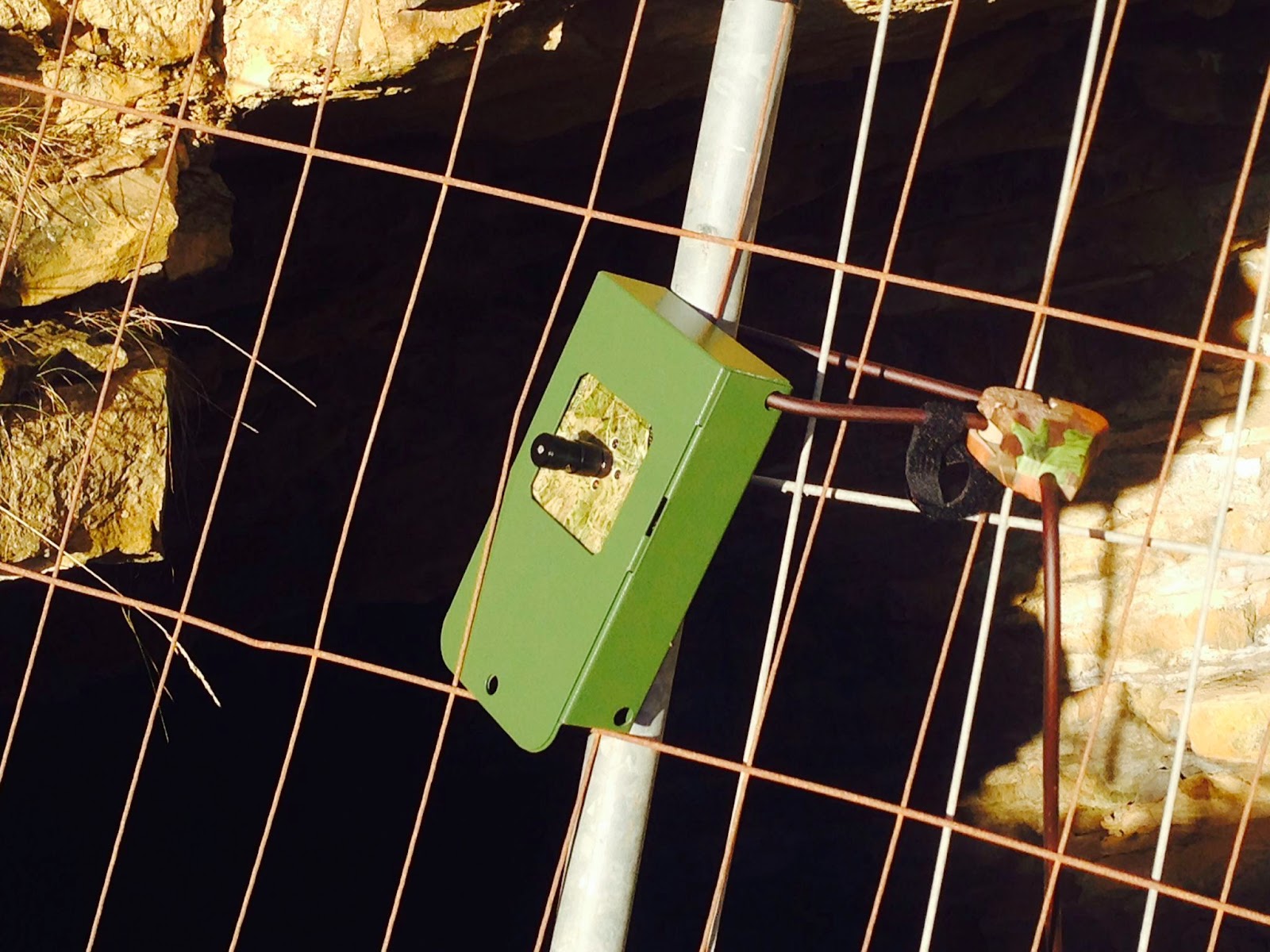
An Anabat Express in use with Titley's optional security system
There are a couple of other issues to consider in comparing the two machines. One is power consumption, Wildlife Acoustics claim that the SM3BAT is less power-hungry than the SM2 models were and claim up to 20 nights on a set of four Alkaline D cells. It can also be used with an external 12 volt battery or power supply. The Express can last for up to 30 nights if you use Lithium AA batteries (high capacity Lithium batteries are not an option for D cells, so far as I know). you cannot connect an external 12v battery to the Express, so it's not a machine for long-term use, though 30 nights is a long monitoring period!
The other thing to consider is price. Wildlife Acoustics have abandoned their £1000 price point with the SM3BAT, which sells for over £1400. This compares with £660 for the Anabat Express. In other words you can have two Expresses for the cost of an SM3BAT and still have money left over. I supsect this is the clincher. Both are good machines, both appear to work extremely well and I have had no problems with reliability of either machine. But two machines for the price of one is hard to ignore, especially when the Express is also less likely to be stolen or vandalised and easier to deploy in numbers across a site. For bat groups and those working on a budget the decision seems like a no-brainer. But if you want a long-term installation or if you want something with a well-engineered and professional appearance perhaps the SM3BAT has something to offer.
It's particularly interesting that Wildlife Acoustics have now launched a smaller, lower-cost, ZCA mode only model called the SMZC. From the little I have seen it seems extraordinarily like an attempt to emulate the Anabat Express, though it still has the look of something made in a foundry and weighs 1Kg (the Express weighs 385g). It also lacks the GPS functionality of the Express, but is priced about 10% cheaper, so it may turn out to have something to offer.
Please note that all prices quoted include VAT and appear to be correct at the time of writing. All weights exclude batteries.
See our website: David Dodds Associates Ltd


 A Songmeter SM2 in position, attached to a post. This unit is being operated with two microphones simultaneously.